

U.S. National Security Archive: Why the Bay of Pigs Never Ended

FROM OUR NATIONAL SECURITY ARCHIVES SERIES
Freddie Ponton writes at 21st Century Wire…
More than a month after Cuba charged six exiles with terrorism over the attack and publicly tied at least two of them to a prior terrorism list shared with Washington, Trump’s State Department is still “reviewing” the case while FBI agents move quietly in and out of Havana. At the same time, newly declassified Bay of Pigs files from the National Security Archive (NSA) lay bare an earlier era of U.S. covert war against Cuba built on wishful thinking and deniable violence, casting a long shadow over how this latest incident is understood in Havana. In Miami and Washington, officials talk about “clarifying events.” In Cuba, people talk about a Florida based militant network that used a U.S.registered boat to launch an armed infiltration under the cover of the blockade that is choking the island.
The old war returns
A stolen speedboat left the Florida Keys before dawn, crossed into Cuban waters, and turned a quiet stretch off Villa Clara into a battlefield on 25 February 2026. Cuban authorities said the vessel carried rifles, pistols, scoped AR-style weapons, night optics, radios, body armour, a drone, and nearly 13,000 rounds of ammunition, while international outlets later confirmed the Florida origin, the stolen registration, and the presence of U.S. citizens among the dead and wounded. At least one of the dead and one of the injured were confirmed by U.S. officials as American citizens, all ten men aboard were Cuban nationals living in the United States, and an eleventh alleged accomplice was arrested on land after reportedly coming to meet them on the beach.
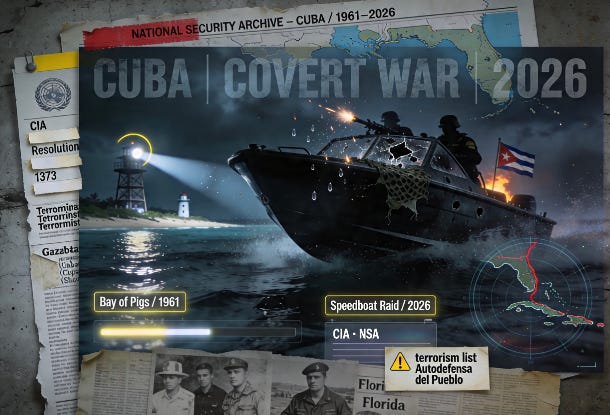
This article places that raid beside newly released Bay of Pigs invasion records by the National Security Archive (NSA), which show how Washington’s covert war on Cuba was built on fantasy, deniability, and a willingness to gamble with Cuban lives. It also documents something more immediate and damning. Years before the Villa Clara clash, Cuba had already identified Autodefensa del Pueblo (ADP), Amijail Sánchez González, and Leordán Cruz Gómez in official counterterrorism files shared with the United States, yet the men still lived, organised, and sailed from U.S. soil.
DOCUMENT: National Security Archive – CIA, Report, “Inspector General’s Survey of the Cuban Operation and Associated Documents,” Top Secret, October 1961, and Che–Goodwin memo (Document Source: NSA)

What follows is not a nostalgic Cold War story. It is an account of how that war against Cuba shrank and mutated inside a permissive exile ecosystem in Florida, and how a country suffocating under sanctions and a de facto oil blockade became the stage for one more armed fantasy of regime change. It is also a story about ordinary Cubans paying the price for a siege they did not choose, while militants and politicians in the United States treat the island’s crisis as an opening.
What the files reveal
The new Bay of Pigs material is truly a jewel because it exposes the inner logic of the invasion more clearly than the mythology ever did. The CIA Inspector General’s survey concluded that the Agency had no solid intelligence showing that Cubans would rise up to join the invaders, that key assumptions about internal revolt were wishful thinking, and that the fantasy of plausible deniability collapsed before the first shot at Playa Girón. The report depicts an apparatus that preferred to double down on false hopes rather than admit the operation should be halted.
Arthur Schlesinger’s memoranda are just as revealing. They show that after the disaster, President John F Kennedy considered stripping the CIA of much of its covert action role, moving key functions under tighter civilian control, and separating intelligence collection from paramilitary operations because the Bay of Pigs invasion had exposed an agency acting like a state within a state. For a moment, the U.S. political establishment admitted to itself that permanent covert war-making might be incompatible with democratic accountability.
The release also exposes the moral rot beneath the operation. One highlighted document ties invasion‑period funding streams to CIA–Mafia assassination plotting against Fidel Castro, while the Guevara–Goodwin memorandum shows that Havana understood the failed invasion not just as an attack survived but as a political turning point that strengthened the revolution from within. Che Guevara told presidential adviser Richard Goodwin that the fiasco allowed Cuba to consolidate internally and to negotiate with Washington as an equal, not as a pleading victim.
For readers interested in the Bay of Pigs invasion, these details matter because they strip away the fairy tale of a bungled but benign policy. The record shows an operation driven by self-deception at the top, by exile militarism on the ground, and by a covert bureaucracy that kept feeding presidents optimism when honesty would have required killing the mission.
The file trail from 1961 shows how Washington once orchestrated an invasion. The file trail from Havana shows what happened when Florida militants tried to do it themselves…
Continue this story at 21st Century Wire
Patrick you are an outstanding journalist. Enjoy your walk and talks also.
If I am understanding this correctly, Cuba is in just as bad as shape as Venezuela of being 🔩’d over by the see 👁️ Aaaa?